This is a chapter of wider Schild surname history, not a confirmed branch of our direct family line. See the research question later in this story.
At eighteen, Erwin Schild was imprisoned at Dachau. Decades later he returned to Germany again and again, not seeking revenge, but conversation. His life stretched from Nazi persecution to more than forty years of religious leadership in Canada and a remarkable commitment to reconciliation.
A German Childhood
Erwin Schild was born on March 9, 1920, in Cologne Mülheim, a district of Cologne on the right bank of the Rhine. His father Hermann Schild was a businessman, and his mother Hetti, née Neugarten, kept a household that grew to include three children. Erwin was one of two siblings, an older brother Kurt and a younger sister Margot.
For a Jewish family in Germany in the 1920s, this was, for a time, an ordinary life. What changed it was not a single event but a gradual tightening, year by year, of what a Jewish family in Germany was permitted to do. Nazi persecution did not begin with camps. It began with smaller things: a school a child could no longer attend, a trade a father could no longer practice, a neighborhood that slowly stopped feeling like home.
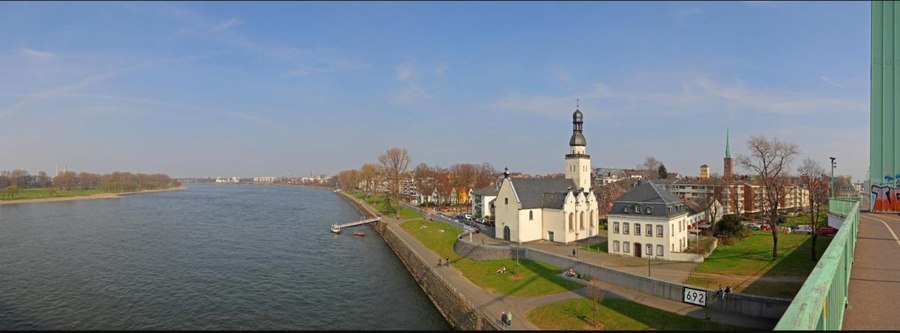
Cologne Mülheim on the Rhine, photographed today, where Erwin Schild was born in 1920.
Photograph by A.Savin, 2012, CC BY SA 3.0, via Wikimedia Commons.
Education Under Pressure
As Nazi policy against Jewish students hardened through the 1930s, Erwin’s schooling was repeatedly disrupted. He moved between a general gymnasium and a Jewish gymnasium as circumstances required, and still managed to earn his Abitur, the German school leaving qualification, in 1938. University study was closed to him. Instead, in April 1938, he enrolled at the Israelitische Lehrerbildungsanstalt, the Jewish Teachers Seminary in Würzburg, one of the last institutions still training Jewish teachers and religious leaders inside Germany.
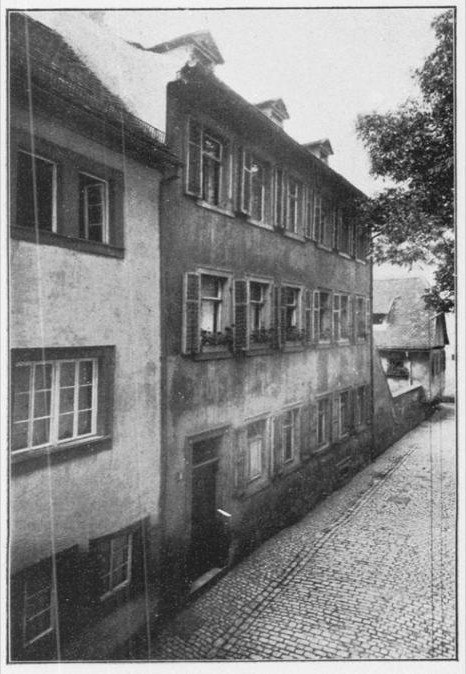
The seminary building at Kettengasse 6 in Würzburg, photographed in 1914, decades before Erwin studied there.
Photograph by Nathan Bamberger, 1914, public domain, via Wikimedia Commons.
November 1938
On the night of November 9, 1938, the pogrom later known as Kristallnacht reached Würzburg. A mob broke into Erwin’s dormitory and destroyed furniture, though the students inside were not physically harmed in that first assault. The following day was worse. Erwin watched the seminary building burn, its library and its Torah scrolls consumed with it, and could do nothing to stop it.
In the roundup that followed, Erwin and other students were arrested. This was not a single dramatic night so much as the visible edge of a policy that had been building for years, now turned openly violent and nationwide.
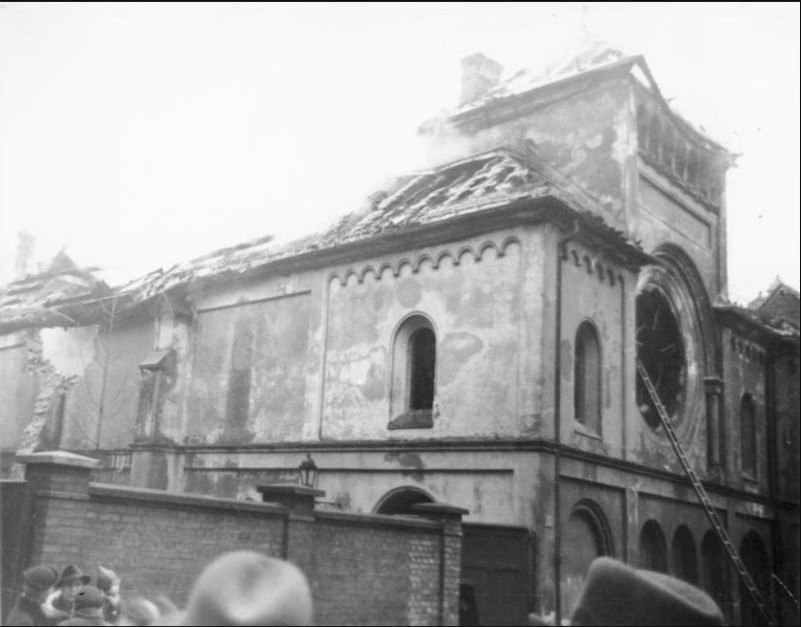
The Ohel Jakob Synagogue in Munich, photographed after the November 1938 pogrom. This is not Würzburg, and no rights cleared photograph of the seminary itself from that week has been located. It is used here to show the scale of destruction taking place across Germany that week.
Bundesarchiv Bild 146–1970–041–46, CC BY SA 3.0 DE, via Wikimedia Commons.
Holocaust Survivor Erwin Schild Remembers the Burning of Books
In this short USC Shoah Foundation testimony, recorded decades later, Erwin Schild recalls the burning of books written by Jewish authors during the pogrom, and his own attempt to save some of them.
Erwin Schild’s own recorded testimony, published by the USC Shoah Foundation.
Dachau
At eighteen years old, Erwin Schild was imprisoned at Dachau concentration camp from November 12 to December 13, 1938. The Dachau Remembrance Book, the camp memorial’s own official record, confirms these dates directly.
Conditions inside were harsh and deliberately humiliating: shaved heads, thin uniforms regardless of weather, poor food, and roll calls carried out under the constant threat of violence. This account does not attempt to tell the full history of Dachau as a camp, a subject far larger than any one person’s experience of it. It stays close to Erwin’s own month there. After a little over four weeks, he was released, on the condition that he leave Germany immediately.
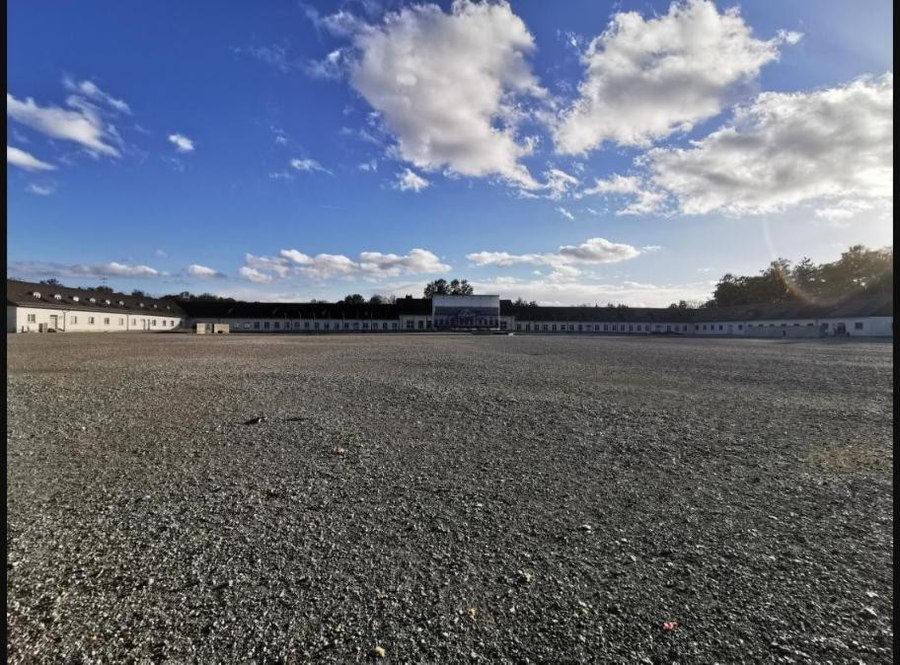
The former roll call yard at Dachau, photographed as it appears today, preserved as a memorial and historical site.
Photograph by Netha Hussain, 2021, CC0, via Wikimedia Commons.
Escape
After his release, Erwin left Nazi Germany. He traveled first to the Netherlands, then, in the spring of 1939, on to Britain, where he resumed his religious studies at a yeshiva in London. The sources available to this archive do not record every stop along the way in detail, and this account does not invent a more exact route than the evidence supports.
- Cologne Mülheim, Germany
- The Netherlands
- London, England
- Canada
An Enemy Alien
What happened next is one of the more surprising turns in Erwin’s story. In May 1940, as Nazi Germany advanced through Western Europe, British authorities classified Erwin, a refugee who had himself fled Nazi persecution, as an enemy alien. Wartime nationality policy at the time treated many German and Austrian nationals in Britain as security risks, regardless of why they had actually left their home country. Erwin was swept into that policy, not because of anything he had done, but because of the passport he still carried.
He was deported to Canada, arriving at Quebec City in July 1940, and interned there alongside other refugees, and in some camps alongside actual prisoners of war. It is an uncomfortable irony worth stating plainly: a young man who had survived Dachau spent the next stretch of the war behind Canadian barbed wire, classified by the country that eventually became his home as a danger to it.
Studying Behind Barbed Wire
Even while interned, Erwin continued his religious studies, using what materials and instruction the camps allowed. It is a small detail next to everything else in this story, but a striking one: a young man who had already lost a great deal chose, again, to keep learning. He was released in February 1942, with assistance from the Canadian Jewish Congress.
Freedom and Toronto
After his release, Erwin settled in Toronto and resumed formal study, enrolling at the University of Toronto and at a yeshiva there. He completed his rabbinical training and was ordained. Most North American sources place his ordination in 1947, the same year he became rabbi of Adath Israel Congregation. One German language biographical source instead gives December 1944 for a rabbinical ordination. This account follows the majority of sources for the timeline that follows, and notes the discrepancy rather than quietly resolving it.
In September 1947, Erwin became rabbi of Adath Israel Congregation in Toronto. The congregation then numbered roughly one hundred fifty families. It was his only pulpit position, and he remained its rabbi for more than forty years.
Building a Congregation
Under Erwin’s leadership, Adath Israel grew substantially. In 1957 the congregation celebrated the dedication of a complete synagogue home, and by 1965 further growth required another major building project, a western addition later formally named the Rabbi Erwin Schild Wing. Erwin retired from the pulpit in 1989 and was named Rabbi Emeritus, succeeded by Rabbi Steven Saltzman. Across those forty two years, Adath Israel grew from roughly one hundred fifty families into one of Toronto’s larger and longer serving congregations.
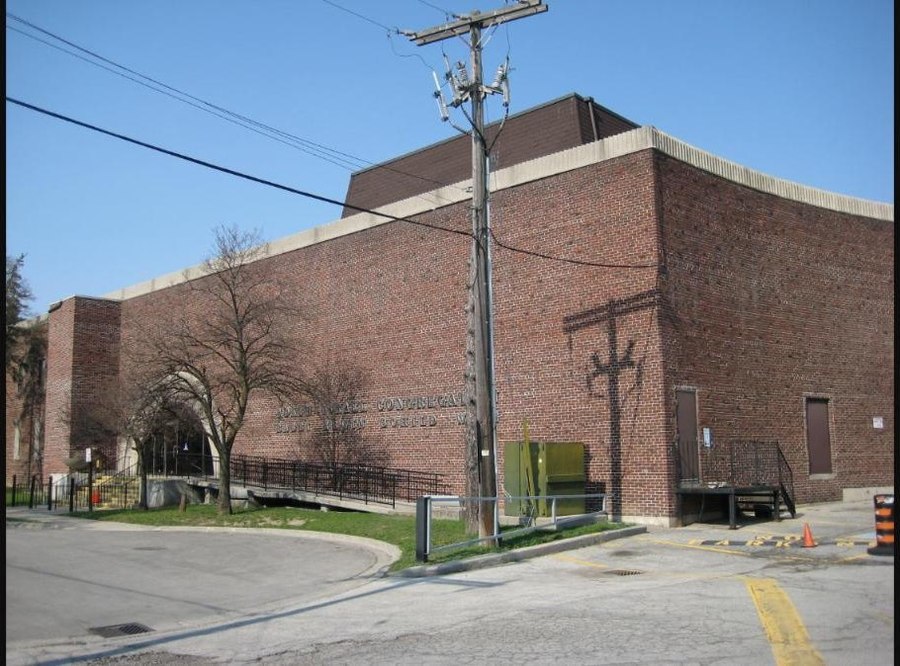
Adath Israel Congregation, Toronto, where Erwin Schild served as rabbi from 1947 to 1989. A later expansion of this building was named the Rabbi Erwin Schild Wing.
Photograph by SimonP, 2010, CC BY SA 3.0, via Wikimedia Commons.
Erwin Schild in His Own Words
Recorded around his one hundred third birthday, this conversation lets visitors hear Erwin tell his own story, in his own voice, rather than only reading about him.
A conversation with Canada’s oldest Conservative rabbi, Erwin Schild, recorded on the occasion of his one hundred third birthday.
Returning to Germany
Later in his life, Erwin began returning to Germany, the country that had imprisoned him at eighteen and murdered his parents. He did not go seeking revenge. He went to speak, to teach, and to listen. Over the years he lectured throughout Germany, took part in community conversations, and became a steady, visible presence in Christian and Jewish dialogue there.
This return matters as much as the persecution that came before it. A young man who had every reason to turn away from Germany entirely chose, decades later and repeatedly, to walk back into it.
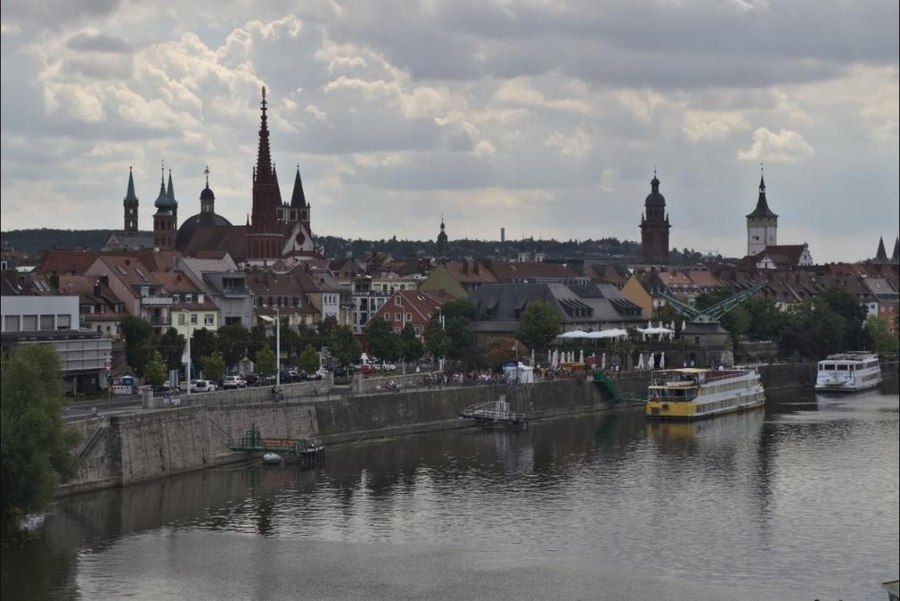
Würzburg today, rebuilt along the Main river. Erwin returned to lecture in Germany many times in his later life.
Photograph by Robert von Oliva (naruciakk), 2022, CC0, via Wikimedia Commons.
Reconciliation
Erwin devoted significant effort in his later decades to improving relations between Christians and Jews. This work was never about forgetting or minimizing what had happened to him, his family, and millions of others. He remained, throughout, a Holocaust survivor who spoke openly about that history. Reconciliation and remembrance sat together in his life, not in opposition to one another. Understanding him means holding both at once.
Recognition
In 2001, Erwin was made a Member of the Order of Canada, the country’s highest civilian honour. The award was announced on May 30, 2001, and he was invested on October 17, 2001. The Governor General’s citation states that he devoted many years to improving Christian and Jewish dialogue, promoting harmony, multiculturalism, and positive interfaith relations, and that he traveled extensively throughout Germany as an invited lecturer.
Germany also recognized his reconciliation work. In 2000, he received the Officer’s Cross of the Order of Merit of the Federal Republic of Germany, one of that country’s significant civilian honours.
Writer and Scholar
Erwin also wrote about his experiences and his life. His confirmed books include an autobiography, The Very Narrow Bridge, subtitled A Memoir of an Uncertain Passage, along with World Through My Window and The Crazy Angel, a collection of essays and sermons. No copyrighted text from these books is reproduced here.
- The Very Narrow Bridge: A Memoir of an Uncertain Passage — his autobiography
- World Through My Window
- The Crazy Angel — essays and sermons
One Hundred Three Years
Decades of congregational leadership followed, and later decades of reconciliation work in Germany. He died in Toronto on January 6, 2024, at the age of 103.
A life that began in a Germany that had rejected him became, across a full century, something closer to a bridge between the country he lost and the community he helped build in its place. It is a life best understood whole: the persecution and the survival, but just as much the forty years of leadership and the decades spent, freely and repeatedly, returning to speak with the country that had once imprisoned him.
Family Loss
In 1941, Erwin’s parents, Hermann and Hetti Schild, were deported along with his younger sister Margot to the Riga ghetto. Hermann and Hetti did not survive. Margot survived further camps and a death march, was liberated, and later settled in the United States. His older brother Kurt had already emigrated to the United States in 1940, described in one account as among the last Jews able to leave Germany, and later served in the American military.
Available sources agree on this outcome for the family while differing slightly in the detail each records. This account follows the fuller, more specific version rather than repeating both without resolving them, and flags that difference here rather than silently picking one.
A Research Question
Is Rabbi Erwin Schild connected to our direct Schild family line?
Erwin Schild’s life and family background are extensively documented, drawn from a German memorial project, Adath Israel Congregation, the Governor General of Canada, and Canadian press coverage.
A direct genealogical connection between his German Schild family and the family line represented elsewhere on this site has not yet been established.
If you have information that connects, or rules out, a link between these two branches of the Schild name, the archive would welcome it. Get in touch.
People in This Story
Places in This Story
Documents
Memorial Record
Dachau Remembrance Book, Erwin Schild
Honours Citation
Order of Canada Citation, Erwin Schild
Historical Photograph
The Jüdische Lehrerbildungsanstalt Building, Würzburg
Historical Photograph
A Synagogue Destroyed During the November 1938 Pogrom
Contemporary Photograph
Dachau Memorial Site Today
Contemporary Photograph
Cologne Mülheim on the Rhine
Contemporary Photograph
Würzburg Old Town and the Main River
Contemporary Photograph
Adath Israel Congregation, Toronto
Portrait Photograph
Portrait of Rabbi Erwin Schild (Photograph Pending)
Event Photograph
Erwin Schild’s Return Visits to Germany (Photographs Pending)
Congregational Photograph
Erwin Schild at Adath Israel (Photographs Pending)
Family Photograph