
This is a chapter of wider Schild surname history, not a confirmed branch of our direct family line. See the research question later in this story.
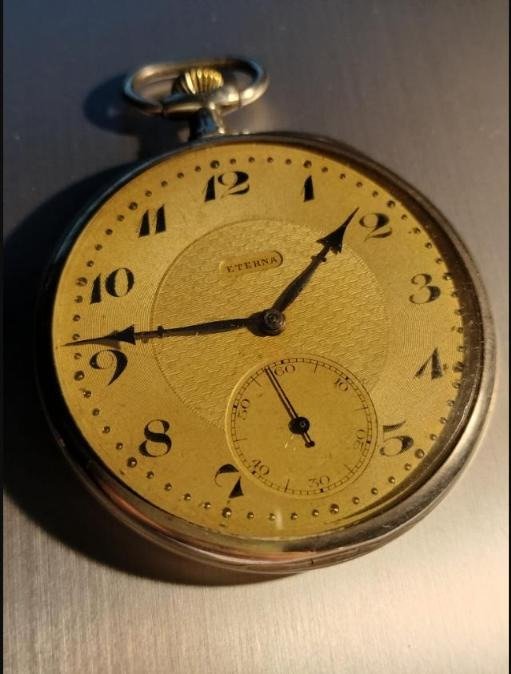
An Eterna pocket watch, circa 1930. By this date the name first registered by the Grenchen workshop had grown into a watch sold around the world.
Photograph by Clyde94, 2023, CC BY SA 4.0, via Wikimedia Commons.
Why Grenchen
Today, Grenchen is a small city in the Swiss canton of Solothurn. In the middle of the nineteenth century it was a modest village of a little over a thousand people. What changed its path was a decision, in the early 1850s, to bring watchmaking to the town.
Grenchen sits in a part of Switzerland where watchmaking had already taken hold in nearby towns and valleys. Local workshops began producing parts for the watch trade, and as one factory succeeded, it drew suppliers of cases, balance wheels, and finishing work around it. Within a few decades, Grenchen had grown roughly tenfold and become one of the country’s most important watchmaking centers, home to companies that are still known worldwide today, including Eterna, ETA, Fortis, and Adolph Schild SA.
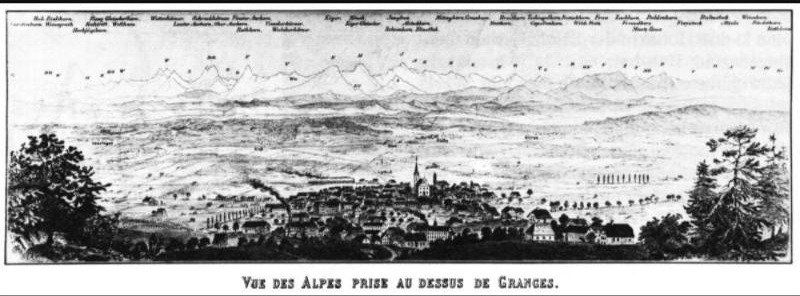
Grenchen seen from above, in a print from the 1870s. Two steam powered watch factories are visible among the buildings below, including the site later associated with Eterna.
Public domain print, via Wikimedia Commons.
The Beginning, 1856
On November 7, 1856, a schoolteacher named Urs Schild and a physician, Dr Joseph Girard, founded a small business in Grenchen making watch movements. In the trade, a raw, unfinished movement like this is called an ebauche. The new firm did not make finished watches at first. It made the parts that other companies assembled into them.
Around 1866, Dr Girard retired and Urs Schild took full ownership of the business. Under his direction, and using new water and steam powered machinery, the workshop grew steadily. By the late 1870s it had taken a major step forward: it began producing complete watches of its own, not only the movements inside them.
What They Actually Made
A watch movement is the mechanical heart of a watch, the small engine of springs and wheels that keeps time and moves the hands. A mainspring stores energy when the watch is wound. A gear train, a chain of small wheels, carries that energy through the movement. An escapement releases the energy in tiny, even steps. And a balance wheel swings back and forth many times a second, acting like a tiny pendulum that regulates the speed of the whole system. Put together, these parts are what let a watch tell time accurately, hour after hour.
View a simple watch movement diagram
Illustration: the main parts of a mechanical watch movement. This is a generic schematic, not a depiction of any specific Eterna or ETA movement.
From a Small Workshop to an Industrial Name
The move into complete watches was a turning point. Over the following decades, what had begun as a two person partnership grew into a business employing hundreds of people and shipping watches around the world.
These figures describe the business as a whole, drawn from published company histories and reference works.
The Schild Family Business Grows
When Urs Schild died in 1888, the business did not pass to a single heir. It passed to his brother Adolf Schild, his widow, and his sons Max Schild and Theodor Schild — each profiled below under People in This Story.
Max Schild took the lead first, pressing for an ambitious plan to modernize production. The plan met resistance, and Max left the company in 1898. His brother Theodor took charge the following year and led the business for more than three decades, guiding it firmly into the emerging wristwatch era. Meanwhile Adolf Schild, Urs’s brother, struck out on his own in 1896 to found a separate movement company, A. Schild SA, which would later become part of the story too.
Where a family relationship is not fully documented, it is described here only as far as the sources support, rather than filled in with assumption.
Eterna
The name Eterna was registered as a trademark in Switzerland on November 11, 1905, nearly fifty years after Urs Schild and Dr Joseph Girard first opened their workshop. Under Theodor Schild’s leadership, the company built a reputation for innovation, including an early patent for a protective watch lug and, in time, some of the first wristwatches to carry an alarm function.
By the twentieth century, Eterna had grown from a single Grenchen workshop into an internationally recognized Swiss watch brand, its name appearing on watches sold across Europe and beyond. The pocket watch pictured near the top of this story, made around 1930, carries that same Eterna name on its dial.
Eterna pocket watch, circa 1930.
Photograph by Clyde94, 2023, CC BY SA 4.0, via Wikimedia Commons.
ETA
Most people who have never studied watches have still, without knowing it, worn one built around an ETA movement. ETA became one of the largest and most important producers of watch movements in Switzerland, supplying the mechanical heart found inside an enormous number of the world’s watches, across many different brands.
ETA’s roots run through the same Grenchen business Urs Schild founded in 1856. As the company grew through the twentieth century, its movement making operations and its watch making operations were reorganized more than once, and in 1932, during a period of difficulty across the Swiss watch industry, the watch business, Eterna, and the movement business, ETA, became separate companies. Both stayed rooted in Grenchen, and both trace back to the same 1856 beginning.
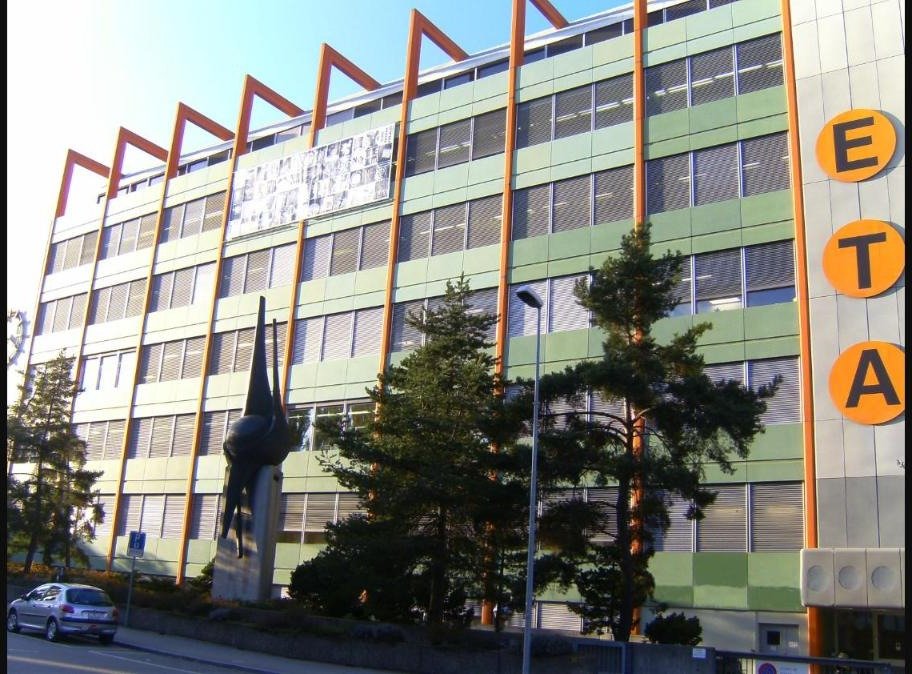
An ETA factory building in Grenchen. ETA remains one of the largest producers of Swiss watch movements today.
Photograph by Landrit Jan Kenan, 2009, CC BY SA 3.0 and GFDL, via Wikimedia Commons.
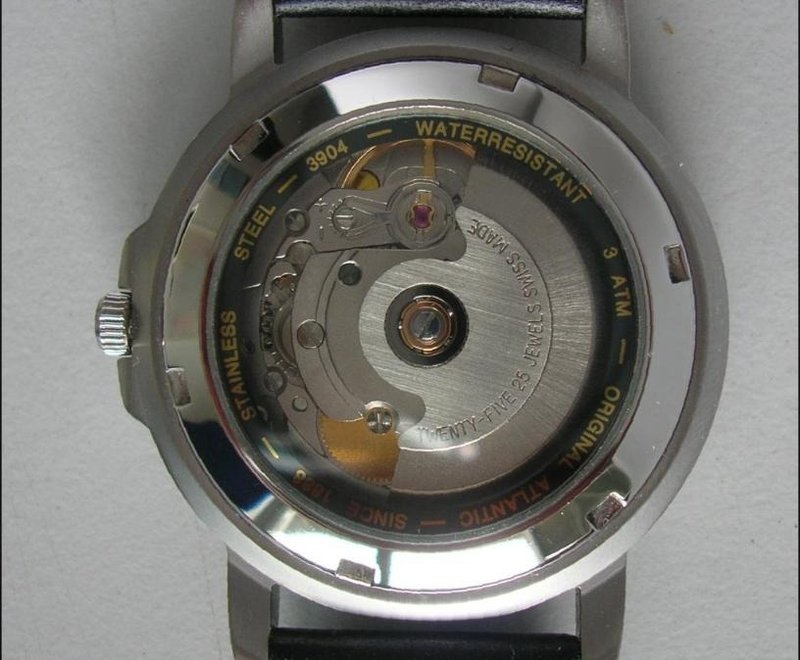
A real ETA 2824 automatic movement, the kind of everyday movement ETA is best known for producing.
Photograph by Jpr, 2008, CC BY SA 3.0, via Wikimedia Commons.
Why This Matters to Schild History
The rest of this archive follows the Schild name through census records, land deeds, and a Texas Hill Country town. This story follows it somewhere else entirely: into workshops, factories, and watch cases in a small Swiss city most of the family may never have visited.
Even without a proven family connection, this is a significant chapter in the wider history of the Schild name. The name was not only present in family records and homes. In Switzerland, it also became part of the story of modern watchmaking, worn on wrists and carried in pockets far beyond any one family.
Urs, Adolf, Max, and Theodor Schild are presented here as part of Swiss watchmaking history, not as confirmed ancestors of the family documented elsewhere on this site.
The Schild Name Today
The Schild name did not disappear from watchmaking. A contemporary Swiss watch brand, trading as Schild 1896, describes itself as reviving the Schild name in watchmaking, tracing back to the same 1896 date when Adolf Schild founded A. Schild SA. The short video below, published by that brand, gives its own account of that legacy.
SCHILD, About Us. Published by the Schild Watches YouTube channel.
This is the brand’s own telling of its history, not independently verified by this archive.
A brand using a family name is not the same thing as a proven family connection. This video is included as a modern echo of the Schild name in Swiss watchmaking, not as evidence linking any particular family to Eterna, ETA, or the direct line documented elsewhere on this site.
A Research Question
Are the Swiss watchmaking Schilds connected to our direct Schild family line?
The historical role of Urs Schild and the Schild family in Swiss watchmaking is well documented, drawn from multiple independent reference sources on the history of Eterna and ETA.
What has not yet been established is whether this branch is directly connected to the Schild family line represented elsewhere on this site. Until that link can be shown, this story stands on its own as wider surname history.
If you have information that connects, or rules out, a link between these two branches of the Schild name, the archive would welcome it. Get in touch.
Closing
A watch is a small, ordinary object that most people carry without a second thought. But somewhere inside a great many of them, past and present, is a lineage of craftsmanship that runs back to a schoolteacher and a physician in a Swiss village in 1856. The Schild name appears not only in family records passed down at home, but also in the quiet, precise work of building the objects that measured time for people all over the world.
People in This Story
Places in This Story
Documents
Company History Record
Founding Record — Dr Joseph Girard and Urs Schild, Grenchen
Historical Illustration
View of Grenchen, Switzerland, Circa 1870s
Historic Watch
Eterna Pocket Watch, Circa 1930
Factory Photograph
ETA Factory Building, Grenchen
Watch Movement Photograph