
Waco, Texas · 1925
August W. Schild Jr. was born in Waco, Texas, on March 1, 1925. Two decades later, his path would lead across the Atlantic and into the air war over Europe.
War Changes Everything
By the early 1940s, the United States was fighting a war on two fronts. Like millions of Americans of his generation, August entered military service — in his case, the United States Army Air Forces, in the Army Air Corps era. He would go on to serve overseas as part of a heavy bomber crew.
Technical Sergeant August W. Schild Jr.
Technical Sergeant
August W. Schild Jr.
- Service No.
- 18227495
- Role
- Radio Operator
- Squadron
- 513th Bombardment Squadron
- Group
- 376th Heavy Bombardment Group
Drawn from the 376th Heavy Bombardment Group’s enlisted personnel roster and August’s obituary.
Inside a B-24 Liberator
As radio operator, August was responsible for the aircraft’s communications — sending and receiving messages, monitoring frequencies, and keeping the crew in contact with their base and formation. Like most radio operators on a B-24, he was also part of the aircraft’s combat crew, manning a gun position when the aircraft came under fighter attack.
View B-24 crew position diagram
Illustration: approximate B-24 Liberator crew positions, with the radio operator highlighted. This is a generic schematic, not a depiction of August’s specific aircraft or crew.
The Liberandos
August served with the 376th Heavy Bombardment Group, nicknamed “The Liberandos.” Flying B-24 Liberator bombers, the group operated in the Mediterranean theater — first from North Africa, later from Southern Italy — and flew long-range missions into occupied Europe over the course of the war.
These figures describe the 376th Heavy Bombardment Group as a whole, not August personally.
513th Bombardment Squadron
Within the 376th, August served in the 513th Bombardment Squadron — one of four squadrons that made up the group, alongside the 512th, 514th, and 515th. No squadron insignia has yet been verified for reuse here, so this squadron is represented in the plain typographic style used throughout this archive rather than an invented emblem.
From Texas to the Mediterranean
August’s service carried him from Central Texas to a unit based on the other side of the world. The map below shows unit and geographic context — it is not an exact reconstruction of August’s personal travel route, which has not been documented.
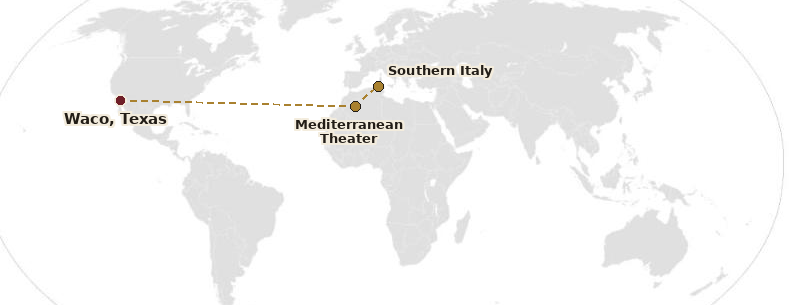
Not to scale — unit and geographic context, not August’s personal flight path.
Base map: Canuckguy et al., public domain (Wikimedia Commons); route and place markers added.
- Waco, Texas — birthplace
- Mediterranean Theater — unit’s area of operations
- Southern Italy — unit airfields later in the war
The Air War Over Europe
From its Mediterranean bases, the 376th Heavy Bombardment Group flew long-range combat missions against targets across occupied Europe, including operations against oil refineries, marshalling yards, and industrial targets in Hungary, Austria, Czechoslovakia, and Yugoslavia — and took part in the group’s well-known low-level raid on the Ploesti oil fields in Romania.
This is unit history. It describes where the 376th Heavy Bombardment Group operated — not a record of which of these missions August personally flew.
Researching His Missions
Which missions did August actually fly?
August W. Schild Jr.’s service with the 513th Bombardment Squadron and 376th Heavy Bombardment Group is documented in the group’s enlisted personnel roster and his obituary. But his individual crew assignment, aircraft, and personal mission list have not yet been identified.
The 376th flew 451 combat missions during the war. Which of these, if any, involved August personally is not yet known — this is an open research question, not a documented fact.
The University of Texas Briscoe Center for American History preserves a major archive of 376th Heavy Bombardment Group material — photographs, correspondence, mission records, intelligence reports, and oral histories — that may eventually help answer this question.
Returning Home
August W. Schild Jr.’s obituary records his service as a radio operator/gunner and his rank of Technical Sergeant, alongside the fuller record of his life after the war. As with the rest of this story, only what the family’s records confirm is presented here; further detail can be added as it is found and verified.
Legacy
Behind the service number and squadron records is a young man from Waco who left home for a war fought an ocean away, and came back. The details of any one mission may never be fully known — but his service, and his place in the Schild family story, are.
People in This Story
Places in This Story
Documents
Obituary
Obituary — August W. Schild Jr.
Military Personnel Roster